Deacon Kevin Mukri preached (on John 6:51-58, my favorite Gospel) at the Mass I celebrated this weekend. His words which are below were clear, profound, and inspiring. Believing that what I had just heard was from the Holy Spirit, I whispered to him when he returned to his seat, "awesome"!
---------------------------------------
"The Jews are scandalized by Our Lord’s command to eat His body and drink His blood. This was cannibalism. They could not believe. Two thousand years later, most still do not believe Our Lord. With over 26,000 Christian denominations in the United States, only... the Catholic Church (and the Orthodox) ensures that believers eat His body and drink His blood. But far more tragic are reports that 70% of Roman Catholics believe that the Holy Eucharist is only a symbol of Our Lord.
The Eucharist is an incredible gift, the gift par excellence, for it is the gift of Our Lord Himself. But what happens to us when we receive the Holy Eucharist? One way to understand is to look at natural law. It is a fact of natural law that lower nature is always assimilated by higher nature.
Plants assimilate the chemical elements from the ground. The chemicals receive a higher existence in the plants. Plants are often eaten and assimilated by animals. The plants receive a higher nature as part of animal nature. We eat beef/pork/fish and it is assimilated into a higher nature, our human nature. When we receive the Holy Eucharist, we don’t change the body and blood of Christ into our nature, but Our Lord changes us into His higher, divine nature.
This is amazing.
In 2003, Pope John Paul II, of his blessed memory, released his encyclical letter “Ecclesia de Eucharistia” in order to rekindle the Eucharist “amazement” by the faithful. It is a marvelous letter on the Eucharist, but there are two points that are extremely important: The first is that the Eucharist is an expression of our communion with Our Lord, both the visible dimension and invisible dimension. We express our visible communion with Our Lord by attending Mass today and saying the Nicene Creed.
Our invisible communion with Our Lord is our own spiritual life and attempts for conversion. Because the Eucharist is the supreme sacrament of the living, this communion cannot be obtained by those “dead” through mortal sin. This is why Our Lord established the sacrament of Reconciliation to ensure we have His help and forgiveness on our earthly journey—a close bond exists between the Sacraments of Eucharist and Reconciliation.
The second point is that Our Lord did not leave us without giving us the means to receive His body and blood. Through His command to “do this in memory of me,” Our Lord left us a great gift, the priesthood, received through Episcopal succession going back to the apostles, and perfected through the Sacrament of Holy Orders.
Because the Eucharist is a sacrifice, if we had no priests, we would have no Eucharist. Could it be that the growing shortage of priests is a result of the high percentage of Catholics who say that the Eucharist is only a symbol? I think so. But the Holy Father said we can reverse this trend by praying for vocations and inspiring young men to answer Christ’s call by our conscious, active and faithful participation in the Eucharist.
If we strive for conversion, Our Lord thorough His body and blood will absorb us into His Divine Nature, give us His peace, love and joy, and use us to bring his peace, love and joy to our family, friends, society and world. When our journey is over, He will keep His promise that “He who eats my flesh and drinks my blood has eternal life, and I will raise him up on the last day”" (Jn 6:54).
Tuesday, August 22, 2006


Monday, August 21, 2006
Who goes to Heaven?
To continue our recent discussion about Judgement, here are some of the notes I use when I give my talk about Heaven, Hell, and Purgatory. I've posted the notes on Hell (8/11, 8/14), and the first half of notes on Heaven (8/18). Here are the second half of my notes on Heaven; I'll post notes on Purgatory soon. Hope it helps!
------------------------------
3. How long does Heaven last?
Scripture
Jesus
-speaks of heaven many times as "everlasting life…eternal life…living forever"
St. Paul (1 Cor 9:25) + St Peter (1 Pet 5:4): "imperishable crown"
Church
-"the enjoyment (of those in heaven) has continued and will continue without any interruption and without end until the last Judgement and from then on forever" (Pope Benedict XII, 1336)
4. Who goes to Heaven?
Scripture- Jn 3:16- "everyone who believes in (God’s only Son) may not perish but may have eternal life"
Jesus
- Jn 6:54, 58 – "whoever eats my flesh and drinks my blood has eternal life…and will live forever"
- Mk 16:16- "whoever believes and is baptized will be saved"
- Mt 25: 35-36-whoever feeds the hungry, clothes the naked, etc.
- Lk 10: 25-28 (the lawyer) / Mt 19: 16-22 (the rich young man)- whoever keeps the Commandments
St. Paul
- "it is by grace that you have been saved, through faith; not by anything of your own, but by a gift from God" (Eph 2:8)
St. James
- "if good deeds do not go with (faith), (faith) is quite dead" (2:17)
St. John
- "whoever does the will of God remains for ever" (Jn 2:17)
Revelation
- "the people who have been through the great trial" (7:14)
Magisterium
-"those who die in God’s grace and friendship and are perfectly purified live for ever with Christ" (CCC, #1023)
-baptized by water (#1228), by desire (#1260), or by blood (#1258)
-in union with the bride of Christ, the Church (Eph 5:25-27): Heaven is the wedding feast of Christ and his bride, the Church (Rev 19:7-8, 21:9-14, previewed in Isa 61:10-11)
Sunday, August 20, 2006
20th Sunday, Ordinary
This is the main gist of the reflection I gave Friday night during Adoration, based on this Sunday's Gospel, especially John 6:53-54:
On behalf of the Lord, I want to thank you for coming out on a Friday night to Church. We will have Adoration every Friday night from 7-8 pm here, and all are invited.
What a great part of the cycle of readings at Mass we are in these 4-5 Sundays: John, chapter 6, the Bread of Life discourse. This is where Jesus teaches us about the Eucharist. He spends more time on this teaching than on any other. It is a matter of life and death, as he tells us in John 6:53-54. “Unless you eat the flesh of the Son of Man and drink his blood, you have no life within you. Whoever eats my flesh and drinks my blood has eternal life”.
In the Eucharist, then, we have eternal life! Now, someone may hear these lines from Christ, and think that the Eucharist is how we get to Heaven when we die. Certainly, that is part of what this means. But, the Lord says that when we receive the Eucharist, we have eternal life. At that moment! So, as we walk back to our pew after receiving Holy Communion, we have eternal life dwelling within us…in our bodies and our souls! We have the Kingdom of Heaven in us. We are tabernacles of Christ, carrying Him with us.
For us tonight, these verses mean that we are in the Presence of Eternal Life. We come out on a Friday night to be in a chamber of Heaven, gazing upon our Lord. We come to adore Christ, who is the Kingdom of Heaven. We have come to be in the Presence of Peace…in the Presence of Joy…in the Presence of Happiness…in the Presence of Love. As we look upon the Lord in adoration, we can see Peace and Love with our own eyes. We can see our God!
We also think about who else is here with us in the Eucharist. Where there is the Son, there is the Father and the Spirit. God is truly One. The Blessed Mother is here and all of the saints and angels. The Eucharist is where Heaven and Earth unite. All those who are in the Kingdom of Heaven are with us tonight, spiritually, and at every Mass. This amazing reality is what we call the “communion of saints”.
I celebrated my first funeral Mass as a priest this morning…for an infant. While it was very sad, it was also a beautiful celebration! This beautiful family of Baby Ikesi’s is a family of faith. Faith makes all the difference. They had baptized Ikesi, so we truly believe he is a saint in Heaven! I explained to them about the communion of saints, and how he would be spiritually present during the Mass in the Liturgy of the Eucharist. It’s an awesome reality…he is still with them!
So, we come tonight to say, “thank you, Lord. Thank you for this amazing gift of the Eucharist. Thank you for allowing us to be in your presence tonight. We ask you to bring us your peace, your joy, and your love. This is a peace and joy and love that we can’t find anywhere else in the world. Help us to experience Eternal Life on Earth. Help us to come to you more faithfully in this Eucharist so that we might experience happiness on Earth. So that we might experience Heaven on Earth”.
Saturday, August 19, 2006
"Either Jesus is God or a blasphemous liar"
Last week, Anony wrote: "I had an interesting conversation the other day with my non-Catholic friends. I asked them if they believed in the risen Christ and they said they did. Actually they believed all the aspects of Jesus. I then asked why didn't they convert to Christianity and the answer was they believed in all prophets that came to the world whether it be Muhammed, Buddha etc. Their fundamental belief was that all religions were the same. They went on to say that all the prophets have said "Follow me and you will attain salvation." What are your thoughts on this?"
Thanks for the question, Anony, and great witness! My first reply to someone who puts other prophets on the same level as Christ is, "how many of them have risen from the dead?" Christ is the only one. That's what separates him from any other prophet or religious leader. The Resurrection of Christ shows us that he has power that no other human person has: power over death. It reveals that Christ is not just a man, like all the other prophets are. It shows that all that he taught is true, and that He is the Son of God and the Savior for whom mankind has been waiting.
St. Paul says that if Christ isn't risen from the dead, Christianity is pointless. "If Christ has not been raised, then empty is our preaching; empty, too, your faith" (1 Cor 15:14). C.S. Lewis wrote, "In the face of foolishness that contends that Jesus was a good man or a prophet or a wise moral guide, but that He was only a man, that Jesus is either God or a blasphemous liar". Msgr. Thomas Wells added, "Let us play no games of trying to make Him into a teacher of unforgettable sayings. He is either the God who will judge me or a liar".
Anony, this is a direct challenge to your friends who believe "all the aspects of Jesus" but only on a level of being a good prophet or something. Either he is "the Way, the Truth, and the Life" (Jn 14:6) or he is not. Either "no one comes to the Father except through (Christ)" (Jn 14:6) or not. Either Christ is "I AM" (Jn 8:58) -the God revealed in the Old Testament - or he is not. Either he is the "living bread that came down from heaven" (Jn 6:51) or he is not.
If we believe that the Bible is the Word of God, then we believe that Jesus is the Christ, the one to follow. All of the Old Testament points to Christ, and the New Testament looks back on Christ. Christ is the Word of God. He is written about indirectly in the Old Testament and directly in the New. If someone rejects Jesus as the Christ, then they reject that the Bible is the written Word of God. Either Sacred Scripture is the Word of God or it is not.
What would Jesus say about others who claim, "follow me and you will attain salvation"?
"Beware of false prophets, who come to you in sheep's clothing, but underneath are ravenous wolves. By their fruits you will know them" (Mt 7:15)
"If anyone says to you then, 'Look, here is the Messiah!' or 'There he is!' do not believe it. False messiahs and false prophets will arise, and they will perform signs and wonders so great as to deceive, if that were possible, even the elect" (Mt 24:23-24).
Friday, August 18, 2006
What is Heaven like?
Friday night Adoration: All are invited to spend at least a few minutes with Jesus in the Eucharist tonight in the SAA Church from 7-8 pm.
----------------------------------
To continue our recent discussion about Judgement, here are some of the notes I use when I give my talk about Heaven, Hell, and Purgatory. I've posted the notes on Hell (8/11, 8/14). Here are half of my notes on Heaven; I'll post the other half in the next few days, and then Purgatory. Hope it helps!
1. Does Heaven exist?
Scripture
Gen 1:1 "In the beginning, God created heaven and earth" (Heaven is as real as earth)
Exodus 16: manna – "bread from heaven"
Mt 3: 16-17: – "And suddenly there was a voice from heaven…this is my beloved son"
Jn 1:33 – "I saw the spirit come down on him like a dove from heaven and rest on him"
Jesus refers to Heaven about 170 times in the Gospels
(Heaven, Kingdom of Heaven, Kingdom of God, Life, and Eternal Life)
-"how blessed are the poor in spirit: the Kingdom of Heaven is theirs" (Mt 5:3)
-"there will be more rejoicing in Heaven over one sinner repenting than over ninety-nine upright people who have no need of repentance" (Lk 15:7)
St. Paul
"God…gave us a place with him in heaven, in Christ Jesus" (Eph 2:6)
Acts of the Apostles
"This Jesus who has been taken up from you into heaven will come back in the same way as you have seen him go to heaven" (1:11)
Revelation: "Then, in my vision, I saw a door open in heaven" (4:1)
" Then I saw a new heaven and a new earth" (21:1)
Early Church
St Cyprian (3rd cent.) "to delight in the joy of immortality in the kingdom of heaven with the righteous and God’s friends
Magisterium of the Church
Pope Benedict XII (1336): "According to the general disposition of God, the souls of all the saints…have been, are, and will be in heaven, in the heavenly kingdom and celestial paradise with Christ" (Benedictus Deus)
2. What is Heaven like?
Scripture
Jesus
Kingdom of heaven is like:
- " a buried treasure"
- "a great pearl" (Mt 13:44-46)
- "a wedding feast" (Mt 22:1; Mt 25:1); "wedding feast of the Lamb" (Rev 19:7)
- "the upright will shine like the sun in the kingdom of their father" (Mt 13:43)
- whatever we sacrifice for Christ in this life, we will receive " a hundred times as much…now in this present time and, in the world to come, eternal life" (Mk 10:30-31)
St. Paul
"what no eye has seen and no ear has heard, what the mind of man cannot visualize; all that God has prepared for those who love him" (1 Cor 2:9)
St. John
"see him as he really is" (1 Jn 3:2)
Revelation: 21: 1-4
Saints / doctors of the Church
St Catherine of Siena:"The indescribable sweetness of this perfect union cannot be told by tongue, which is but a finite thing"
St John of the Cross: " Were (the soul) to have but a foreglimpse of the height and beauty of God, she would not only desire death in order to see him now forever, as she here desires, but she would very gladly undergo a thousand singularly bitter deaths to see Him only for a moment"
Magisterium of the Church
- "perfect life with the most Holy Trinity – this consummation of life and love with the Trinity, with the Virgin Mary, the angels and all the blessed" (Catechism of the Catholic Church, #1024)
- "Heaven is the ultimate end and fulfillment of the deepest human longings, the state of supreme, definitive happiness" (CCC, # 1024)
Thursday, August 17, 2006
Falling in love with Christ
Friday night Adoration: All are invited to spend at least a few minutes with Jesus in the Eucharist this Friday in the SAA Church from 7-8 pm.
----------------------------------
"I know what the Lord has done for all of us and yet there is some resistence to say the rosary, go to the Eucarist, go to Mass and all it is plain laziness nothing more. How can I overcome this?" I greatly appreciate this question from an anonymous blogger that strikes a cord for all of us more than we'd like to admit.
During my college years, I had great trouble waking up in the morning (I love sleep!). When I first started to go to Adoration as a junior at Maryland, I committed to the 6-7 am hour on Thursdays (in those days, St. Mark's in Hyattsville had Perpetual Adoration - this is when Jesus is exposed in the Blessed Sacrament 24/7 - at least one person has to be there every hour of the day). I woke up every Thursday morning at 5:30 to be there by 6...a minor miracle! I was highly motivated to spend time with Jesus. It was the best hour of my week, outside of Mass!!
The spiritual life of any Christian is all about a relationship with Christ. If it's on this level, I really can't imagine someone being lazy for too long. If you fall in love with someone, you WANT to be with them. So it is with Christ. When we enter into a friendship with Him and try to get to know Him better (which is different from knowing about Him), we find ourselves falling in love with Him. We fall in love with the peace and joy that only He can give us. We fall in love with the Truth that he brings us. We fall in love with Him who is Love.
If we have a REAL experience of His peace and joy, then we want more. An example of this involved a woman from another parish. I was walking her to the rectory door after our meeting, and as we walked past the door to the rectory chapel, she asked, 'what is in there?'. I said 'Jesus'. We went into the chapel, and prayed in the presence of our Lord for a few minutes. Something happened to her in those brief moments. She experienced a REAL presence in that chapel. She experienced a REAL peace that moved her. Since then, she has spent many hours with Christ in chapels around town, and at one point said, "I just want to be with Him all the time!"
I would suggest to a person suffering from laziness, then, that he/she make a commitment (no matter how small) to consistently spend time with Christ. An idea would be to come to what we're doing now at St. Andrew's on Friday nights: Adoration! We will expose the Eucharist on the altar in Church every Friday from 7-8 pm. Make a commitment to stop by and spend at least a few minutes with Christ each week with an open heart and mind. Trust me, He will reward you.
"If but a pin is given in homage, and given with a good heart, it will be enough for Jesus, Who loves only the good will" - St. Louis de Montfort.
Wednesday, August 16, 2006
Christ and the Church are one
Friday night Adoration: All are invited to spend a few minutes at least with Jesus this Friday in the SAA Church from 7-8 pm.
----------------------------------
An anonymous blogger wrote recently, "I was wondering one thing. What do we say to anti-Catholics who think our relgion is from an evil entity?" While it is a very broad question, I appreciate you asking it here. First of all, I would need to know the person or group to whom I'm speaking. What is their background with faith? In what church do they worship? What do they know about the Catholic Church? These and other critical factors are things that I find out about those who are being critical of the Church.
I can give a few general points that could be used, and used effectively. First, I would point out how some people viewed the person of Christ. Specifically, some people called Christ himself evil. "This man drives out demons only by the power of Beezebul, the prince of demons" (Mt 12:24). They continually called him a liar and blasphemer, and wanted to kill him long before Good Friday. We see in Jesus' passion and death that many of the people surrounding him thought that he was so evil that he must be crucified (punishment for only the worst crimes in ancient times).
Next, I would say that Christ promised similar treatment for those in the Church. "If the world hates you, realize that it hated me first" (Jn 15:18). The Apostles especially experienced this because they continued to perfom the works of Christ (forgive sins, cast out demons, e.g.) and teach as He taught. So, all of them (except John) received the same treatment as Christ: they were hated and put to death.
Also, I would remind those to whom I'm speaking that what we say about the Church, we say about Christ. Christ and the Church are one; Christ is the head, the Church is the body (see Col 1:24, Eph 5). St Paul even says in Ephesians 5 that Christ is one with the Church as a husband is one with his wife. "Husbands, love your wives as Christ loved the Church" (v.25). The Church is the visible sign of Christ on Earth.
Finally, the living tradition of the Church shows a living tradition of love. For 2000 years, there have been numerous examples of devout men and women who faithfully lived according to the precepts of the Church. They lived heroic virtue; we call them saints. Blessed Teresa of Calcutta is a great example. Here was a woman who believed and lived everything that the Church teaches. She lived heroic love that the world has never seen. Yet, some called her a phony. Some called her evil...just like Jesus.
At the heart of Christ is Love. At the heart of the Church is Love. At the heart of the saints is Love. Anyone who says differently doesn't know what (or Who) Love is.
Tuesday, August 15, 2006
To Jesus through Mary
Last week, Christine Regan wrote: "One area I really have never explored or understood very well is the topic of Marian devotion. I have been told as Catholics, part of our faith that distinguishes us from other denominations includes special attention to the Virgin Mary. Though this has interested me, this area of our faith was never really explored or explained in my years in Catholic school, though very important, and has made it difficult to learn more. I have been thinking about it lately and would really enjoy reading up on the importance of our Holy Mother in our lives and how I can learn from her example. Any suggestions?"
Thanks, Christine, for your timely question about our Blessed Mother. Today is the day we celebrate the feast of the Assumption of the Blessed Virgin Mary; this feast commemorates Mary being taken up into Heaven, body and soul. It is such an important event that the Church has made August 15 a solemnity (the highest feast) each year, and a Holy Day of Obligation. The Assumption is a beautiful celebration of Mary's immaculate life on Earth and entry into heavenly glory.
When we think about Mary's role in our own lives, we can think about how important our own mothers are to us. It is through the 'yes' to life that our mothers said so many years ago that we exist. It is through the 'yes' to love that they said in raising us that we are the people that we are today. We are the results of their love. Put in a more spiritual way, we are the fruit of their wombs.
Mary said 'yes' to God her whole life; she never sinned. Specifically and most importantly, she said yes at the Annunciation when God asked her to give birth to his Son. She was a teenager (b/w 14-16 years old)!! By the power of the Holy Spirit (see Lk 1:35), Mary conceived Christ in her womb. It is through Mary that Christ entered the world. It is through her that Salvation, Love, Peace, Mercy, and Truth entered the world. It is through her that Eternal Life entered the world.
Christ (and Christianity) is the fruit of Mary's womb! We say in the 'Hail Mary', "blessed is the fruit of your womb, Jesus" (cf Lk 1:42). What fruit she bore in her womb! She conceived, gave birth, nurtured, cared for, and raised our Savior! How important is Mary in God's Plan of Salvation! Everything we have in Christ comes about through her. We have life in Christ through her.
Mary is the Mother of God and our mother (cf. Jn 19:26-27). Just like with our own mothers, we give thanks to God for our Mother in Heaven and regularly turn to her for help. Christ comes to us through Mary. So, we are to go to Jesus through Mary*.
------------------------------------------------
*I will post in the near future about how to go to Jesus through Mary; one way is to pray the Rosary. In answer to someone's recent question, we should pray the Rosary (five decades, at least) every day, as Mary has requested in her apparitions.
Monday, August 14, 2006
"Hell is not spoken of anymore" (cont.)
This is a continuation of my post from Friday which responded to a blogger's question about Hell. I will post my notes on Heaven and Purgatory in the near future. Once again, we have nothing to fear in we live in the Grace of Christ.
-----------------------------------
c. How long does Hell last?
- “eternal fire, eternal punishment, eternal separation”
- Lk 16:19-31 The rich man and Lazarus
- “a great gulf has been fixed, to prevent those who want to cross from our side to yours or from your side to ours”
d. Who goes there? (we know there are souls in Hell, but can’t know specifically whom)
Scripture
Jesus : see notes from previous post +
- “all evil doers” (Mt 13:41)
- “many take the road that leads to destruction” (Mt 7:13)
- “the elect are few” (Mt 22:14)
- “it is easier for a camel to pass through the eye of a needle than for someone rich to enter the kingdom of Heaven” (Mt 19:24) - referring to someone whose god is money
- is Judas in Hell? can't say for sure, but Jesus says it is “better for that man (by whom the Son of Man is betrayed) if he had never been born!” (Mt 26:24)
-“anyone who does not remain in me is thrown away like a branch-and withers; these branches are collected and thrown on the fire and burnt” (Jn 15:6)
St. Paul
- "those who behave in these ways (sexual vice, impurity and sensuality, the worship of false gods and sorcery, antagonisms and rivalry, jealousy, bad temper and quarrels, disagreements, factions and malice, drunkenness, orgies and such things) will not inherit the kingdom of God" (Gal 5:18-21; cf. 1 Cor. 6:10)
St. John
- “sin that leads to death” (1 Jn 5:16) - i.e., mortal sin
Church
-“those who die in mortal sin without repenting and accepting God’s merciful love means remaining separated from him for ever by our own free choice” (Catechism of the Catholic Church, # 1033).
- mortal sin:
1. grave offense (it's wrong) -mainly, direct offenses against the Ten Commandments
2. full knowledge (I know it's wrong)
3. full consent (I freely choose to do it)
CCC, 1861:
- "mortal sin is a radical possibility of human freedom, as is love itself. It results in the loss of charity and the privation of sanctifying grace, that is, of the state of grace.
- "if it is not redeemed by repentance and God's forgiveness, it causes exclusion from Christ's kingdom and the eternal death of hell, for our freedom has the power to make choices for ever, with no turning back.
- "However, although we can judge that an act is in itself a grave offense, we must entrust judgment of persons to the justice and mercy of God" (in other words, we can judge an action as a grave offense, but only God can judge what's in a person's heart; that's why we can never say that "so and so" is in Hell; also, we don't know if at the moment of death that he/she showed some sign of repentance-'Lord, have mercy' - that God would take into account in his infinite Mercy)
4 distinctions of Hell:
a) damned - eternal punishment
b) limbo (Abraham’s bosom) - holy souls (from OT) there until Christ freed them
c) limbo (infants) – not official teaching; but "Holy Innocents"?
d) purgatory - temporal punishment
-“God predestines no one to go to Hell" (CCC, #1037)
- Hell is the result of free will, and ultimately, God's Love
- God loves us so much that He has given us free will in order that we will choose to be with Him in Heaven
- He respects our free will so much that He allows us to choose to reject Him; He helps us so much in our lives (with His grace) to choose Him, but won't ever force us to love Him
- our free will is REAL (the "power to make choices for ever, with no turning back")
- God wills each of us to choose Heaven, but allows us to choose Hell
---------------------------------------------------------------------
Fatima prayer: "O my Jesus, forgive us our sins, save us from the fires of Hell. Lead all souls to Heaven, especially those most in need of thy mercy."
Sunday, August 13, 2006
19th Sunday, Ordinary - Homily
It’s interesting to think about how much time we spend each week or even each day watching movies or television…listening to music…surfing the internet. There are a variety of reasons why we spend so much of our free time on these different media. We might feel that movies make us laugh or make us cry. We might experience certain emotions through a character or like a particular actor. Movies entertain us. But, the question is, are movies real? For the most part, no they are not. And yet, we invest so much time, money, and energy in them.
Then, we ask the question that many people don’t like to answer. How much time do we spend with God each week? I trust that it's at least one hour a week…at Mass. So, the question is, is what happens at Mass real? Yes!! If we have some understanding of what takes place during Mass, then we know that what happens here blows away any movie that’s ever been made. God appears before our very eyes! In probably my favorite line from Scripture, Jesus tells us in John 6:51 from today’s Gospel that this is true: “the bread that I will give is my flesh for the life of the world”.
What happened on Mount Calvary was real. Even the most ardent atheist in the world would agree that Jesus of Nazareth shed his blood and died on a Cross 2000 years ago. It’s an historical fact. It was really his flesh and blood on the Cross. We differ with the atheist, of course, with what happened three days later in the Resurrection. Christ teaches us in John 6:51 that the same flesh and blood that was on the Cross is the same flesh and blood on the altar at each Mass.
If we put John 6:51 into an equation, we see that “the bread that I will give” (the Eucharist) “is” (equals ) “my flesh for the life of the world”. So, the Eucharist = flesh. The Eucharist that is on the altar at Mass is the same flesh and blood that Jesus offered for the life of the world on Good Friday. People will ask, ‘so, does Jesus die over and over again at every Mass?’ No, Scripture says he “died once and for all”. His sacrifice on Mount Calvary is re-presented on the altar under the signs of bread and wine.
The only difference has to do with what happened since Good Friday: the Resurrection. The Eucharist is the risen body and blood of Christ. It is the same Jesus. What happens at Mass is real, and it is awesome, baby! Awesome!!
So, we come to this Mass and every Mass to give thanks to God the Father for all the blessings He has bestowed upon us. In a special way, we give thanks for the Eucharist. Eucharist comes from the Greek word, ‘eukaristeion’ (sp?), which means ‘thanksgiving’. We thank Jesus for this incredible gift. Thank you, Jesus, for your sacrifice for us. Thank you for giving us your life. Thank you for the Eucharist. Thank you for your life. Thank you for your love. Thank you, Jesus.
Saturday, August 12, 2006
Comments!!
All comments of sincere bloggers on these sites are welcome on this site, even ones that contain personal attacks and judgements on Fr. Greg. This is an open forum. But, recently, we have had an enormous amount of unwelcome comments: those by spammers. These have been comments which contain links to all kinds of sites; yes, all kinds of sites.
So, I was forced to install "word verification" last night. What this means is that you simply type in the word that comes up on the screen when you try to publish a comment. Sorry that we have had to do this, but it's the best way to prevent the filth that these spammers bring.
Thanks for your patience and support (especially my SFA backers!!).
Friday, August 11, 2006
"Hell is not spoken of anymore"
Confessions and Adoration, tonight (8/11), 7 pm, SAA Church - We will expose the Eucharist and I will be available in the Church booths for Confession this Friday, starting at 7 pm. All are welcome!
---------------------------------
An anonymous blogger wrote last week: "This is not pertaining to the theme but I was wondering one thing. When I was growing up and going to CCD classes, Hell was a big component of it. If you didn't go to Mass, didn't listen to your parents etc. were all roads that led to Hell we were taught. Hell is not spoken of anymore. Have the standards changed as to what could lead you there or has it become more symbolic?"
Thanks for this important question! Here are some of the notes I use when I give my talk about Heaven, Hell, and Purgatory (Judgement). I will post the notes on Hell first over the next week or so, and then Heaven, then Purgatory. Hope it helps! Please keep in mind that if we live in the Grace of Christ, we have nothing to fear.
Hell
a. Does it exist?
Scripture
Jesus
- refers to Hell 28 times and eternal punishment about 90 times in the Gospels
- uses the terms Hades, Gehenna, Eternal Fire, Field of blood
- Mk 9:43-48, e.g.
- Mt 10:28-“fear him rather who can destroy both body and soul in hell”
- Mt 25:46- those who don’t care for the least of Christ’s brothers and sisters “will go away to eternal punishment”
-“wailing and grinding of teeth”
- the good-for-nothing servant (Mt 25:30)
- children of the kingdom (of darkness) – Mt 8:12
- the man not dressed for the wedding feast – Mt 22:13
St. Paul
- for those who “refuse to accept the gospel of our Lord Jesus…their punishment is to be lost eternally, excluded from the presence of the Lord”(2 Thess 1:9)
St. Peter
- “when angels sinned, God did not spare them: he sent them down into the underworld and consigned them to the dark abyss to be held there until the Judgement”(2 Pet 2:4)
Book of Revelation
- “all those who worship the (devil) …will be tortured…forever”(14:10)
Church
– early Church Fathers described Hell as “eternal punishment”; affirmed by early Church councils and Pope Benedict XII (1336)
- St Teresa of Avila: "I was at prayer one day when suddenly, without knowing how, I found myself...plunged into Hell...I felt a fire within my soul the nature of which I am incapable of describing. My bodily sufferings were so intolerable...and these are nothing by comparison with the agony of my soul, an oppression, a suffocation and an affliction so deeply felt"
- Fatima* – vision of Hell by children: sea of fire; demons and souls with burning embers, black and transparent; terrifying looking animals; children cried out for all to hear
b. What is it like?
-we only know what’s been revealed to us
Scripture (described above)
Church- “hell is a state to which the wicked are condemned and in which they are deprived of the sight of God and are in dreadful torments for all eternity” (Baltimore Catechism)
pain of loss
- being separated by God, rejected by Christ (“I know you not”-Mt 25:12)
- shame, regret, despair
pain of sense (torments)
-“fire” (of Gehenna) – “the chaff he will burn in a fire that will never go out” (Mt 3:12)
- principal means of torments that will be different than earthly fire because it will affect both body and soul
- the pain of the sense will be as nothing compared to the pain of loss
- “We must not ask where hell is, but how we are to avoid it” (St. John Chrysostom)
- Hell is eternal separation from God (Catechism of the Catholic Church)
- “hell is not a punishment imposed by God…it is the natural consequence of an unrepentant sinner’s choice against God” (Pope John Paul II)
- basically, when the person dies, he sees the face of God and he realizes at that moment that he is not worthy to be with God for all eternity; he realizes that he chose hell during his life (GWS)
----------------------------
*Fatima prayer: "O my Jesus, forgive us our sins, save us from the fires of Hell. Lead all souls to Heaven, especially those most in need of thy mercy."
Thursday, August 10, 2006
Wednesday, August 09, 2006
Great discussion on suffering!
Wow, what a great discussion on the SFA site on suffering from my August 1 post, 'Why does God allow suffering?'! Really good insights! In particular, someone asked about how to help his/her sister who suffers much. As we all do, the sister struggles to handle suffering the moment it hits in a Christ-like manner.
Might I suggest meditating on the seven "words" that Christ spoke from the Cross. Please check out my post on the SFA site from April 14, 2006, "The Seven Last Words of Christ".
I would specifically point to the word Christ cries out when he is experiencing some of his greatest pain: "my God, my God, why have you abandoned me?" At this moment, Anon, He is uniting himself to your sister (and to any of us) who feels "so alone in her suffering", as you wrote.
Does this mean that Christ lost his faith in the Father on the Cross? No. One of his next words is "Father, into your hands, I commend my spirit". He is one with the Father always. But, he is showing that, in his human nature, he is truly one with us, even experiencing the greatest pain of all: the pain of feeling alone.
Christ knows exactly how your sister feels, and is probably the only one who really does. And, she knows how He felt. She is united with Him in a very intimate way. If she can unite her words at the moment of agony to his "words", then I would say she is being about as Christ-like as a person can be in her Grace-filled situation.
Tuesday, August 08, 2006
"If you miss Mass..."
Confessions and Adoration, Friday (8/11), 7 pm, Church - We will expose the Eucharist and I will be available in the Church booths for Confession this Friday, starting at 7 pm. All are welcome!
----------------------------------
Yesterday, someone asked, "if you miss a Mass or you haven't been to Mass for a few weeks, are you allowed to take communion?" Good question! If someone intentionally misses Mass on Sunday or a Holy Day of Obligation, then he/she should not receive Holy Communion until he/she goes to Confession. The reason for this is because we can never receive the Body and Blood of Christ in a state of mortal sin.
How is intentionally missing Mass a mortal sin? Well, let's review the three conditions of a mortal sin: 1) Grave offense - it's seriously wrong, 2) full knowledge-I fully know it's wrong, and 3) full consent-I freely choose to do it. It is a grave offense to miss Sunday Mass. Catholics know they need to go to Mass on Sunday. So, if they freely choose to skip, then all three conditions would be met, and the act would be considered a mortal sin. [But, if someone does not freely choose to miss, - e.g., on vacation and no Mass is offered where they are, or no way of getting to Church, or too sick, or homebound - then it's not a mortal sin.] As I wrote in my post last Friday, "receiving Holy Communion in a state of mortal sin is itself a mortal sin".
Any time we are not sure - or have any doubt at all - if a particular sin that we committed during the week was a mortal sin, we should not receive (still come forward, but cross your arms over your chest, and receive a blessing). While this isn't ideal (I would recommend going to Confession asap), the most important point here is to respect the Body of Christ. I have great respect for those who respect the Eucharist, and are not worried about what others in Church might think.
With this in mind, we recall a great blog made here in late July by Pete S, a SAA teen. Pete wrote a pretty amazing post about John 6:53; I agree with most of what he wrote. But, keep in mind that Christ speaks to us here as individuals, and telling us that He is the life of our souls. Without Him, our souls die. Just like if our bodies don't eat food, they will die, so, too, our souls will die without eating spiritual food.
The Eucharist is our spiritual food. It is "eternal life" dwelling within us. It is Heaven on Earth! "Whoever eats my flesh and drinks my blood has eternal life" (v.54) is referring not just to when we die, but now...today...this Sunday. I can experience eternal life...happiness...joy...peace...here on Earth.
But, if we consistently live without the Eucharist, we consistently live without eternal life...happiness...joy...peace here on Earth. If done knowingly and freely, it brings darkness and death to our souls: "no life within you".
Monday, August 07, 2006
Spiritual reading
Recently, someone asked for a list of books that I would recommend for spiritual reading. Here are ten solid recommendations for those in the beginning and intermediate stages of the spiritual life. If anyone is looking for more advanced spiritual reading, please let me know.
1. "Introduction to the Devout Life" by St Francis de Sales (Tan books).
2. "The Story of a Soul" by St Therese of Lisieux (Tan books).
3. "The Sun Danced at Fatima" by Fr. Joseph Pelletier, A.A.
4. "Treasure in Clay" by Archbishop Fulton Sheen (Doubleday).
5. "St Francis of Assisi" by Omer Englebert (Servant Publications).
6. "The Imitation of Christ" by Thomas a Kempis.
7. "The Life of Christ" by Fulton Sheen (Image books).
8. "Modern Saints" by Ann Ball (Tan), Books One and Two.
9. "True Devotion to Mary" by St Louis de Montfort (Tan).
10. "The Lamb's Supper" by Scott Hahn (Doubleday).
Sunday, August 06, 2006
Transfiguration - Homily
Recently, we’ve been having a great discussion on the blog site about modest dress. Many people have written some excellent questions and comments, including two female teens who gave some good insights into why dressing modestly is important. The discussion led to how we should dress for Church. Someone asked, ‘Fr Greg, is there a dress code for Church?’ I said, “yes, wear your Sunday best”. Please check out the blog site for this and other discussions. People have made some really good comments and questions… it is really good stuff.
In today’s Gospel, we hear about the clothing of Jesus. He goes up on the mountain with Peter, James, and John, and among other things, “his clothes become dazzling white”. This vision fulfills so many Scriptures, including the first reading from the prophet Daniel. There are so many parts of the Old Testament and New Testament that speak of the radiance of the clothing of the Son of Man, and how it reveals the glory that will be his in the next life. So, this feast of the Transfiguration is a preview of the glory that Christ will have in its fullness in the Kingdom of Heaven.
If we use clothing to represent our souls, can our clothes become dazzling white? Can we be transfigured? Can we share in the glory of Christ? Well, on the day of our Baptism, this is what our soul looked like (I hold up a white t-shirt). Clean, pure, dazzling white. Ok, so maybe this shirt is not dazzling white…but it is clean! Actually… my laundry is washed here by others, and it’s done quite often. That takes some getting used to…! Anyway, the shirt IS clean!
But, we don’t stay this way for too long, unfortunately. As we get older, we start to make choices that aren’t the best for our souls. We begin to put dirt and filth on our souls. We lose our dazzling whiteness. (I hold up a white t-shirt with some dirt and mud on it) This is what venial sin does to our soul. Sins like gossiping, cursing, dressing immodestly, being an Eagles or a Giants fan...!
Now, very unfortunately, some of us, maybe many of us, make choices that are very bad for our souls. We do things that are seriously wrong and bring serious filth, dirt, and junk to our souls. (I hold up a white t-shirt that is completely covered with dirt and mud) This is what a soul in a state of mortal sin looks like. Yuk!! We can lose our whiteness completely due to sins like deliberately missing Mass on Sunday, drunkenness, fornication, being a Cowboys fan...!
If our souls are in either state, can we become dazzling white? Yes, through Him (I point to the tabernacle) and in Him. If we come to Mass looking like this (I hold up the dirty shirt), we ask God to forgive our sins (at the beginning of every Mass). Then, when we receive the Eucharist in Holy Communion, we go back to our pews looking like this (I hold up the dazzling white shirt). If our souls look like this (I hold up the shirt caked with mud) and we go to Confession, we confess our sins to Christ through the person of the priest. No matter how much filth we have, no matter how long it’s been, if we are truly sorry, Christ will forgive all of our sins. We walk out of the Confessional, and look like this (I hold up the dazzling white shirt). We cannot do this on our own, though. Only Christ can make us dazzling white. The Gospel says that no human cleaner on Earth could have made his clothes that white. Only He can make us totally clean and pure.
In a few minutes, Christ will appear to us in a different way. Just as he appeared differently on the mountain to Peter, James, and John, so he will appear differently to us on this mountain, the altar of God. He will appear to us in the form of bread and wine. As I elevate Him, let each of us call to mind the words of the Father from the Gospel: ‘“This is my beloved Son, listen to Him”…look at Him…through Him, may you all know that I love you’.
Saturday, August 05, 2006
Friday, August 04, 2006
"Let all faithful Catholics come receive our Lord"
Mass and Adoration tonight: All are invited to join us for Holy Mass (7 pm) and Adoration of the Blessed Sacrament (from 7:25 to 8:25) in the Church tonight to honor the First Friday of the month. We'll have quiet prayer, music, and I'll give a reflection. Come for some of it or come for all of it. Please join us!!
----------------------------------------
Just before Holy Communion at every Mass that I celebrate, I say, "Let all faithful Catholics come receive our Lord". One SAA blogger wrote the following comments in response to hearing that invitation:
"When I heard the invitation to communion you offered, I was taken aback. Was I not a 'good and faithful' Catholic because I hadn't been to mass last Sunday? Did your invitation not include me, should I stay in my seat? If I did stay in my seat, would people wonder what I had done that made me not a 'good and faithful' Catholic? I had never heard such an invitation in my many years of attending Catholic masses at various parishes. Perhaps my reaction is the exact one you are looking for- that parishoners should approach communion in a contemplative state- questioning whether their actions were those of a good and faithful Catholic".
The first time I celebrated Mass at the different times here at St Andrew's, I made the following announcement before Holy Communion: "Just as a reminder about who may receive Holy Communion...reception of the Holy Eucharist is reserved for Catholics who are in a state of Grace. If you are able to receive, please come forward and receive either in the hands (with one hand on top of the other, making a throne for our King) or on the tongue. If you are not Catholic or not in a state of Grace, please still come forward and cross your arms over your chest, and you will receive a blessing".
Having given this explanation once at each of the Masses, I don't see the need to reiterate it. However, it is necessary for me to briefly remind those in the congregation at each Mass about the guidelines for reception of the Sacred Body and Blood of Christ. It is very serious business! Keep in mind the words of St. Paul: "whoever eats the bread and drinks the cup of the Lord unworthily will have to answer for the body and blood of the Lord" (1 Cor 11:27) and that he/she "eats and drinks judgment on himself" (v.29).
None of us is truly worthy to receive Jesus in the Eucharist; but, Christ himself commands us to “take this all of you and eat it”. It is the Grace of Christ that makes us worthy. Grace fills us with God and His life, and thus makes us clean and pure. Our souls need to be clean in order to receive our Lord in the Eucharist. They need to be free of the filth that mortal sin brings. If we lose the state of grace through mortal sin, we cannot receive the Lord in Holy Communion; receiving Holy Communion in a state of mortal sin is itself a mortal sin.
The soul that is in a state of Grace has life; the soul that is in a state of mortal sin (“deadly sin” – 1 Jn 5:16) does not. As one commentator has put it, the soul in mortal sin is like a “chamber of death”; if Christ enters this soul, he enters death. It is like bringing about his death… this is what St. Paul means about having to “answer for the body and blood of the Lord”.
So, Anon, thank you for your great question and giving me the opportunity to expound on my invitation at each Mass. One of the reasons I give it is because there are probably non-Catholics at every Mass (I met a Lutheran woman who had been receiving the Eucharist for 2 years; she didn’t know she wasn’t supposed to be). Another reason is what you said which echoes St. Paul that “a person should examine himself” (v.28) before receiving the Body and Blood of Christ.
One of the biggest things that each of us will be judged on is how we respected the Eucharist while here on Earth. It is also one of the greatest things Christ will judge me on as a priest and “guardian of the Eucharist”: did I treat the celebration and distribution of His Sacred Body and Blood with great reverence and care?
Thursday, August 03, 2006
Wednesday, August 02, 2006
Tuesday, August 01, 2006
'Why does God allow suffering?'
First Friday Mass and Adoration, August 4, SAA Church:
Holy Mass at 7 pm, Adoration of the Blessed Sacrament to follow. Please join us!
------------------------------------
Six years ago, I had the great privilege of spending a few weeks in Calcutta, India, with the Missionaries of Charity (Mother Teresa’s sisters). I was there with a few other seminarians working and praying each day with the sisters. One night, the nun who succeeded Mother Teresa as head of the order said something to me that I will never forget. She said, “Greg, those who are closest to Jesus on earth are those who suffer the most.”
Obviously, we saw widespread suffering on the streets of Calcutta. Thousands of people everywhere, even little kids, suffering tremendously from hunger and disease. There was so much filth and heat; such oppressive conditions which I had never fathomed, much less seen. That experience has helped me to better understand suffering. For example, reading the words of the prophet Jeremiah (from today's first reading at Mass) when he saw the vast pains of the people of Judah due to war, famine, and drought: “ my eyes stream with tears… over the great destruction which overwhelms…my people…look! those slain by the sword…look! those consumed by hunger”(Jer 14: 17-18). He’s essentially saying to God, 'Lord, do you see this?' His cries are similar to the question we like to ask, ‘why does God allow suffering?’
Jeremiah arrives at an answer a few lines down in this passage. “We recognize, O Lord, our wickedness, the guilt of our fathers; that we have sinned against you”(v.20). Suffering is a natural result of sin. The Israelites had sinned against God. They had broken the covenant. They worshipped false gods, didn’t keep the commandments, and didn’t love their neighbor as they should.
God’s feelings about those who suffer are most likely the same as Jeremiah’s. God’s “eyes stream with tears” seeing His children in pain. Ultimately, His answer to the question of suffering is that He sends His Son to suffer for our sake. He has not only remembered His covenant with us, He has created a new covenant. This new covenant is centered on the suffering, death, and resurrection of Christ. If anyone wishes to live the new covenant with the Lord, he or she must center their lives on the cross of Jesus Christ, on which He suffered tremendously. Jesus himself says, “if anyone wishes to come after me, he must deny himself, take up his cross, and follow me” (Lk 9:23).
The reward for those who suffer is not found in this life. Jesus says,“my kingdom does not belong to this world” (Jn 18:36). All those in Calcutta, those here in America, the sick and the dying, those in our family, our friends, ourselves, anyone who endures suffering in any form for the sake of love is a great friend of Jesus Christ. Jesus promises eternal rewards for His close friends. For all those who have imitated Him so well and united their suffering to His, Christ proclaims in today's Gospel: “the righteous will shine like the sun in the kingdom of their Father” (Mt 13:43).
Monday, July 31, 2006
Sunday, July 30, 2006
17th Sunday, Ordinary - Homily
Normally, when I am giving a talk to a group about the Holy Sacrifice of the Mass and what takes place during the Mass, I can stump the group with one question: what is the moment of consecration? When do the bread and wine actually become the Body and Blood of Christ? I will reveal the answer to this group in a few minutes. Now, when we hear this Gospel, we might ask the same question…when does the multiplication of the loaves and fish actually take place? One minute we hear that there are five loaves and two fish, and the next minute…they “have their fill”.
It’s kind of like here at Mass…the multiplication of Catholics at Mass. When we processed in, there was practically no one here. And, now, as I give the homily…poof…the place is full! Nevertheless, we see many similarities with this Gospel and what takes place at Mass.
The first reading is a preview of the multiplication of the loaves and fish. They are almost identical stories; the story involving Elisha in the second book of Kings occurred 500 years Before Christ. Like all Old Testament events, it leads to and is fulfilled in the New Testament. The events of the Old Testament spoke to the people of those times, but also to the people of later times, particularly the ones who are alive during the time of the Messiah. They prepared people to recognize the Christ, so that they would proclaim him as the Messiah.
In this Gospel from John 6, we hear phrases that remind us of Holy Mass. “A large crowd” came to Christ…we, too, come in large numbers to Christ, to his altar at Mass. They brought him “five barley loaves and two fish”…we bring him bread and wine. These are all ordinary gifts of the earth, and they represent us, humanity. In fact, barley loaves were seen as the food of the poor.
He had them “recline”; he was preparing them for a meal… we prepare for this Sacred Meal by kneeling. He “took the loaves, gave thanks, and distributed them”…we hear the same words from the Last Supper accounts: “he took bread, gave thanks…and gave it to them”. The distribution of the loaves and fish is a preview to Holy Communion. They all “had their fill”…whenever we receive a gift from God, we are satisfied. “Twelve wicker baskets with fragments” were left over…twelve is a significant number because it represents the twelve Apostles. They are all there for this miracle.
Also, when God gives, He gives in abundance. They collected the fragments in the same way that we collect the fragments of the Eucharist, and store any leftover in the tabernacle so that none goes to waste. Finally, witnessing this miracle leads them to have faith. They proclaim that Christ is “the prophet, the one who is to come into the world”…how much more are we who receive the Body and Blood of Christ filled with faith to proclaim him as our God?
The main difference between this Gospel and what happens at Mass is the difference between a miracle and a sacrament. In a miracle, a change in nature takes place that our senses can pick up. The people could see that loaves and fish had been multiplied…that water had been turned into wine…that a blind person could see. But, in a sacrament, we don’t see any change. It’s not a natural change, it’s a supernatural change. We don’t see a change in the bread and wine; we only know by faith that a change takes place... Jesus says, “this is my body”.
The moment of consecration, then, is when the priest says these words of Christ…”this is my body... This is my blood”. Then, it is no longer bread, and no longer wine. That is why we ring the bells at that moment; the bells say, ‘be alert…something extraordinary is happening here’.
So, as we prepare to witness this extraordinary event in a few minutes, this amazing occurrence, we prepare to be fed by our Lord. How much more do we receive our ‘fill’ when we are filled with the Body and Blood of Christ … filled with God’s love? May we know God’s love through the Eucharist this day.
Saturday, July 29, 2006
John 6:54
"Whoever eats my flesh and drinks my blood has eternal life, and I will raise him on the last day" - John 6:54
Friday, July 28, 2006
"Wells stories"
Six years ago, when my good friend, Msgr. Thomas Wells, was murdered in his rectory in Germantown, it sent shock waves through our whole area. Those of us who knew him well struggled to come to terms with life without our spiritual father and good friend. He was one of the wisest, most honest, and most generous people we had known. In many ways, he was a spiritual and intellectual giant.
Also, Fr Wells ("FW") was one of the funnest people any of us had known. So, the other struggle we had was picking out our favorite "Wells stories" because there were so many! There were the golf trips, skiing trips, vacations at the beach, retreats, and various get-togethers at local establishments. While FW undoubtedly spent most of his priesthood helping people in very serious and powerful ways, the more lighthearted moments will be my focus here and in some future posts.
When I first met Fr Wells, he made an impression; I'm just not sure what kind of impression it was! I was answering phones in the evenings at Our Lady of Lourdes parish rectory in 1987. One evening, he came down to my office wearing a t-shirt and swimming trunks with a towel draped over his shoulder. He said, "Hi, I'm the new priest, Fr Wells. I'm going to a pool party. You wanna go?" I said, "Hi. Umm, no, I can't. I have to stay here and answer the phones". He said, "Ok, well, see ya later", and walked away rather hurriedly.
Years later, we were driving down to the Outer Banks for a beach vacation. As we got near Richmond, FW said, "buddy, get a map out of the glove box". I said, "Why? We know the way around Richmond". "Trust Father" is all he said. 'Uh oh', I thought. So, I got the map for him, and sure enough, we began taking a different route than usual. About 20 minutes later, we had gone so far off the highway that we were on dirt roads! Next thing I know, Fr Wells is clapping, hooting, and hollering: "78 cents a gallon!! 78 cents!!" He had found an old gas station that offered one of his favorite pleasures in life: cheap gas.
Now, this is one that I told in a homily a few weeks ago, but it bears repeating. Fr Wells was watching the movie, "Jesus of Nazareth" with friends of his many years ago. "Jesus of Nazareth" is a very long movie. Just as it was reaching its climax in Jesus' Passion, Fr Wells' friends noticed that he was asleep! "Fr Wells, Fr Wells, wake up. You're missing 'Jesus of Nazareth'". Fr Wells woke up, looked around rather dazed and confused, and said, "I know how it ends", and went back to sleep.
Thursday, July 27, 2006
Wednesday, July 26, 2006
Posts from teens about modest dress
Here are two posts from teenage girls from the past few days. The first one was posted over the weekend in response to questions raised about modesty from the SFA site. The second is in response to the post I made yesterday, "One's choice for clothing". Thank you, young ladies!
------------------------
"hey im a female teen and this issue has definitely been brought to my attention since well i dont always dress in the most conservitive way. but after talking to some people about it and it being brought to my attention i thought about it and it definitely makes since that in church girls shouldnt be dressed as if they were on the beach trying to impress someone and since then every time i go to church i check what i am wearing and think about what others would think and if its modest enough i just hope other people start to do that too. great issue to bring up"
------------------------
"I strongly agree with this blog. Its rare to find a teen such as myself agreeing to this. In my group, we're known for dressing proactivley and it gives us a name, the names usually aren't good or respectful because its true dressing like that we are only disrespecting ourselves. The boys are attracted to our physical appearence. Girls often mistake that attraction as the boy liking her that is why alot of girls dress like that. Girls often think dressing more appropriate will turn them off. It might turn the sex craved boys off, but atleast you'll have their respect. And besides its not the sex craved boys you want. Girls are so brainwashed into dressing like that to impress, but it only leads to dirty names and disrespect from your peers and the boys might call you 'sexy' or 'hott', but they'll also say hurtful things out of disprect. Boys see you disrespecting yourself, they'll do the same and take advantage of you. If you want a guy to take you seriously you have to take yourself seriously. I know I have dressed in ways I shouldn't untill I looked at what I got out of it and I wasn't happy. Dressing like that only gives you disrespect, names and guys wanting to use you. Teens really need to realize this. Thank you."
------------------------
"hey im a female teen and this issue has definitely been brought to my attention since well i dont always dress in the most conservitive way. but after talking to some people about it and it being brought to my attention i thought about it and it definitely makes since that in church girls shouldnt be dressed as if they were on the beach trying to impress someone and since then every time i go to church i check what i am wearing and think about what others would think and if its modest enough i just hope other people start to do that too. great issue to bring up"
------------------------
"I strongly agree with this blog. Its rare to find a teen such as myself agreeing to this. In my group, we're known for dressing proactivley and it gives us a name, the names usually aren't good or respectful because its true dressing like that we are only disrespecting ourselves. The boys are attracted to our physical appearence. Girls often mistake that attraction as the boy liking her that is why alot of girls dress like that. Girls often think dressing more appropriate will turn them off. It might turn the sex craved boys off, but atleast you'll have their respect. And besides its not the sex craved boys you want. Girls are so brainwashed into dressing like that to impress, but it only leads to dirty names and disrespect from your peers and the boys might call you 'sexy' or 'hott', but they'll also say hurtful things out of disprect. Boys see you disrespecting yourself, they'll do the same and take advantage of you. If you want a guy to take you seriously you have to take yourself seriously. I know I have dressed in ways I shouldn't untill I looked at what I got out of it and I wasn't happy. Dressing like that only gives you disrespect, names and guys wanting to use you. Teens really need to realize this. Thank you."
Tuesday, July 25, 2006
One's choice of clothing
I would have preferred to post about chastity first, but it’s probably good to answer the recent questions on modest dress now (modesty is part of the life of the chaste person). I’ve included comments from two Catholic experts below to help answer the questions. Regarding the question someone asked about dress codes for attending Mass, my answer is, 'wear your Sunday best!' In the least, men should wear dress pants (not shorts), a dress shirt, and dress shoes; in the least, women should wear a dress that covers the shoulders or a blouse with skirt (past the knees), and dress shoes.
Jason Evert, a young, Catholic chastity speaker and author, writes about modest dress (click on the title of this post for the link to his site):
“I've read tens of thousands of pages of theology and sex ed, but I never learned how to treat a woman until I dated one who dressed modestly. It was captivating, and I realized for the first time that immodest dress gets in the way of seeing a woman for whom she is. Immodest outfits might attract a man to a girl's body, but it distracts him from seeing her as a person. As one man said, ‘If you want a man to respect you, and perhaps eventually fall in love with you, then you must show him that you respect yourself and that you recognize your dignity before God.’
A woman who dresses modestly inspires a guy in a way that I'm not ashamed to admit I cannot explain. I suppose it is safe to say that it conveys your worth to us. When a woman dresses modestly, I can take her seriously as a woman because she isn't preoccupied with clamoring for attention. Such humility is radiant. Unfortunately, many women are so preoccupied with turning men's heads that they overlook their power to turn our hearts”.
Rev. Thomas Morrow has written “A Modesty Proposal”, a leaflet which can be read in its entirety at www.cfalive.org/leaflets. Here are some excerpts:
“I think we would have to be deliberately naive in this age of psychological sophistication to ignore the fact that certain visual stimuli are objectively and normally provocative to the sex drive of the ordinary male. We might close our eyes to this, but the merchants don't. And the fortunes they make by putting their theories into practice prove they know what they are doing... Whether the women and girls of our culture know or do not know what is going on, they lose by it all the same...
A good Christian woman has so much going for her, that even if short skirts and other ‘in’ fashions were a benefit–which they aren't–they would be of minimal importance. A woman living in the state of grace has a bit of an aura which far exceeds any fashion statement. Christian women sometimes underestimate their inner beauty, perhaps because the fashion designers have such a strong influence, placing so much stress on the exterior.”
And, the Catholic Catechism teaches (# 2521, 2522): “Modesty protects the intimate center of the person. It means refusing to unveil what should remain hidden…Modesty protects the mystery of persons and their love… Modesty is decency. It inspires one’s choice of clothing...”
Monday, July 24, 2006
John 6:53
"...unless you eat the flesh of the Son of Man and drink his blood, you do not have life within you" (Jn 6:53).
Sunday, July 23, 2006
16th Sunday, Ordinary - Homily
Well, in about a week, it all starts. That’s right….training camp for the Washington Redskins! When Joe Gibbs came back as coach of the Redskins a few years ago, I imagined that he found a group of men who were lost. They didn’t have a leader. They were like sheep without a shepherd. I bet that one of the first things he did was to teach them. Teach them about football, about playing as a team, and about being like a family. The primary task, then, of a shepherd, is to teach…to lead others and show them the way.
It is a sad situation when we encounter a group of individuals who are lost…who don’t get it…who are ignorant. The prophet Jeremiah says that they live in “fear and trembling”. Jesus saw this when he saw the great crowds who were lost. They appeared “as sheep without a shepherd”. Christ was “moved with pity” when he saw this. What was the first thing he did? He began to teach them. He began to give them a clue.
He began to teach them about the way. He showed them the way…the way to go…the way to live. He is the Way. He began to teach them the truth….the truth about God, about life, and about us. He is the Truth. He began to teach them the life…the life of the Gospel…a life in love…what real love is. He is the Way.
So, my primary job, as one of your shepherds, is to teach. That is the first task of any priest. I will teach you about Christ. How do I know that what will I teach you will be the Truth? Well, Christ does say in John 14, “I am the Way, the Truth, and the Life” (v. 6). But, I look at the Resurrection. No one has ever risen from the dead except Jesus Christ. He is God. He is the Messiah. Everything he says is true. He is the way to heaven….the way to happiness, to peace, to joy, and to love.
Once we get it about Christ, we get it about life. He is God and we are not! Until we see that he is the Way, the Truth, and the Life, we don’t know the way. We don’t know the truth. We don’t know the life. We are like sheep without a shepherd, and it is very sad.
The thing that will probably cause me the greatest sadness as a priest will be when people don’t get it about the Eucharist….when they don’t get it that it is really Him! That it is really His risen Body and Blood under the signs of bread and wine. That God loves us so much that He wants to be in us…in our bodies and in our souls. So, as we receive Jesus in the Eucharist in a few minutes, let each of us pray, “Lord, show me the way. Show me the truth. Show me the life. Show me the love of my heavenly Father.”
Saturday, July 22, 2006
1 Cor 6:19-20
"Do you not know that your body is a temple of the Holy Spirit within you...therefore glorify God in your body" (1 Cor 6:19-20).
Friday, July 21, 2006
Sex: A Beautiful Gift from God
One of the most beautiful gifts God has given us is our sexuality. He has given us this great gift for two main reasons: life and love. From the very beginning, we see how this is lived out specifically. 1) Life - "Be fertile and multiply" (Gen 1:28); 2) Love - "that is why a man leaves his father and mother and clings to his wife, and the two become one body" (Gen 2:24). We understand, then, that God has given us sex for procreation and union between husband and wife.
This is a HUGE responsibility that God has given us! He calls husband and wives to be open to continuing His act of creation through the sexual act; He calls them to "pro-creation". Every new baby continues God's creation through the parents. Also, He calls them to unite their total and complete love for one another in the conjugal act. In this act, they give themselves totally to one another...their bodies and souls. This is the most complete way that they mirror the love between Christ and the Church (see Ephesians 5:21-33).
We can live great holiness through our bodies, then, if we treat the gift of sex as God has intended. However, we can commit great evil if we misuse the gift, and don't approach sex as God intends. ANY SEXUAL ACT OUTSIDE OF PROCREATION AND THE UNION BETWEEN HUSBAND AND WIFE IS SINFUL. Christ himself teaches that fornication is among the most serious sins (see Mk 7:21). St Paul writes that those who commit sexual sins will not inherit the Kingdom of God (see 1 Cor 6:9-10). The Church consistently reminds us to 'do good and avoid evil' through our bodies.
One Catholic author and speaker, Christopher West, argues that the Church's "strict" teachings on sexual morality are signs that She sees sex as a sacred gift. "If the Church's teaching regarding what we should and shouldn't do with our bodies here on Earth is 'strict', this is not because the Church devalues the body, but because she values it so highly. The typical sentiment goes like this: if the Church says you can't do this and you can't do that - everything it seems that people want to do - then the Church must think sex is bad.
Hold on a minute. 'Handle with care' - or even 'handle with extreme care' - in no way means 'this is bad'. What are those things in life that we handle with the most care? Are they not precisely those things that have the most inherent value?
There's a parallel here with the Eucharist. The Church has many 'strict' teachings about who can and cannot receive the Eucharist, how it's to be received, and with what spiritual dispositions. It would be absurd to conclude that the Church is therefore 'down with the Eucharist'. It's no less absurd to conclude that the Church is down on sex. No, both the Eucharist and the union of man and woman are sacred mysteries of the highest value".
Thursday, July 20, 2006
Wednesday, July 19, 2006
Tuesday, July 18, 2006
Trust in Christ
Recently, a blogger wrote a deep couple of questions: "My question is how does totally surrender to God really letting go? I know its all about faith but how do we build that and not have it shatter in our face the moment something goes wrong? Please answer this-this is really important for my spiritual life."
Regarding total surrender to God, please keep in mind what Jesus says about giving up everything for God and his kingdom. For example, he tells the parable of the person who finds a great treasure (which represents the kingdom of heaven) buried in a field, and "out of joy goes and sells all that he has and buys that field" (Mt 13:44). While it is not always easy, it should bring us great joy to give up everything for the kingdom of God. It the greatest treasure on earth.
We don't build up our own faith; Christ does. He nourishes faith through us. Again using a parable, we look at the mustard seed (Mt 13:31-32). The mustard seed cannot grow on its own. With the help of water, the Sun, and air, it "becomes a large bush, and the 'birds of the sky come to dwell on its branches'". Our faith cannot grow on its own. With the help of the water of Baptism, the Body and Blood of the Son, and the air of the Holy Spirit, our faith can grow large enough to move mountains (see Mt 21:21).
With this in mind, then, I would suggest three ways** to allow Christ to build up your faith:
1) Open yourself to his Grace
Our job as believers is to be open to Christ and his Grace. If we remain open, he will give us faith that won't shatter when times get tough. He will bring us closer to Himself, the Prince of Peace. He is the One we need when life gets rough. His Grace will get us through whatever curveballs life throws us: "if God is for us, who can be against us?" (Rom 8:31).
2) Frequent the sacraments
The sacraments are where we receive Sanctifying Grace (the life of God dwelling within us)...where we receive faith. Faith is given in Baptism, nourished by the Eucharist, sealed in Confirmation, restored in Confession, etc. Daily Mass (whenever possible) and monthly Confession are highly recommended for those who wish to go deeper in their relationship with Christ.
3) Pray your tail off
Talk every day to Christ, preferably in his Real Presence in the Eucharist (in a Church or chapel where the Blessed Sacrament dwells). Read Scripture every day (one chapter of the Gospel a night works for many folks), pray the Rosary, Divine Mercy Chaplet, etc. Just as a disciplined athlete exercises every day, so we should work out every day spiritually (see 1 Cor 9:24-27).
Finally, to be a real believer is to trust in Christ. "Fear is useless; what is needed is trust" (Mk 5:36). If I totally surrender to Christ, I give him my life...I give him my love...my problems...my fears... my worries. "Do not worry about your life...your Father knows (the things) that you need" (Lk 12:22,30).
--------------------------------------
** Are there other ways that Christ builds up our faith?
Other Scriptural passages/quotes that speak of this?
Monday, July 17, 2006
SAA Flag Football!!
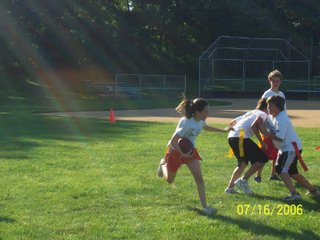
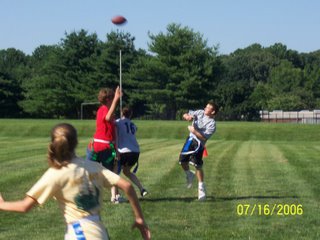
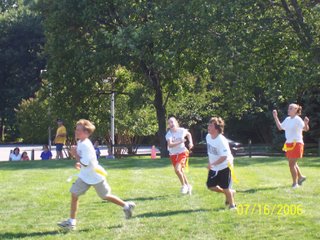
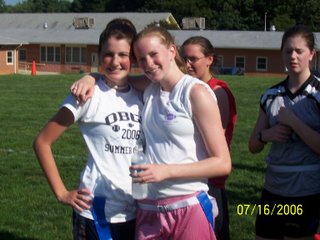
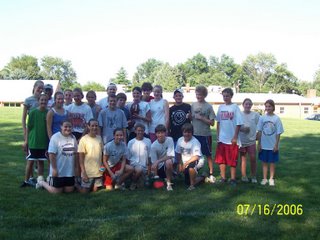
We had our first SAA Summer Flag Football games yesterday, and had a great turnout of youth! Almost 30 teens (along with about 20 adults who watched) braved the afternoon heat to enjoy a few hours of friendly competition and fellowship. What good athletes we have in the school and parish! Both boys and girls impressed the onlookers with dazzling moves, nifty plays, and great effort and enthusiasm!
Thanks to all the teens who came out, our referees, the parents who helped, George Gillespie and the Stifters for the photos, and our seminarian, Dan, who assisted me immensely. See you all next Sunday at 4 pm for more fun!
Here are some photos from the action:



Thanks to all the teens who came out, our referees, the parents who helped, George Gillespie and the Stifters for the photos, and our seminarian, Dan, who assisted me immensely. See you all next Sunday at 4 pm for more fun!
Here are some photos from the action:


Matthew 18:3-5
"Amen, I say to you, unless you turn and become like children, you will not enter the kingdom of heaven. Whoever humbles himself like this child is the greatest in the kingdom of heaven. And whoever receives one child such as this in my name receives me." - Mt 18:3-5
Sunday, July 16, 2006
15th Sunday, Ordinary
Fr. Mike is away this week; he’s on vacation until next week. So, if you hear any loud noise coming from the rectory late at night, it’s probably seminarian Dan and his friends. You know how those seminarians can be… crazy!? Of course, I would never do that. But, back in the day, probably!
It’s funny, when I tell my stories from high school and college to young people, they often say, “wow, you used to have a normal life”. I tell them, ‘I wasn’t always a priest”. It’s like the prophet Amos in the first reading who said, “I wasn’t always a prophet”. Actually, the first twenty years of my life were kind of the opposite of priesthood. Priests live for others; I was living for myself. I wasn’t always a priest.
Without going into detail, let’s just say that I was a great sinner. I didn’t know Christ. I was ignorant. I didn’t know the Gospel. St Jerome said that ‘ignorance of Scripture is ignorance of Christ’. I didn’t know that the Eucharist is really Jesus’ flesh and blood. I didn’t know the dangers of mortal sin, how I need to be in a state of grace when I die if I want to get to Heaven, and that Confession restores me to that state if I've left it. I didn’t know much about the sacraments at all. Many people helped me to know Christ and the Church, but it was mainly priests who helped me to know Him.
This led me to pray …really for the first time in my life at age 21. I began to say, “Lord, show me your Will…I will do it”. It led me to enter the seminary at 23. Now, the seminary was a good time, and I enjoyed my years there. But, it was also a great struggle for me. The whole celibacy thing was huge! It was all so new, after the life I had led. For about 10 years, I ran from it, leaving the seminary twice. It wasn’t until two years ago that I finally realized that celibacy is a gift that God is offering me, and I embraced it. Now, the joy of living this gift as a priest is indescribable!
I said the first weekend I was here that I am PSYCHED to be here. If you start to understand the struggles that I’ve had…that for so many years I was begging God to show me His Will. If God doesn’t make His Will very clear to us, trying to discern It can be the hardest thing in life! I prayed, “Lord, show me my bride. Whether it’s a woman and family in marriage or a parish family as a priest, just show me the one to whom I’m supposed to give my life”. So, the day that Cardinal McCarrick told me that I was coming to St Andrew’s is the day that God showed me my bride! To be here with you to see your faces brings a happiness that I can’t describe!!
Christ has sent me here to you just like he sent the Apostles. He has sent me here like he sent so many priests to me…to help you to know Him. He has sent me here to preach the Gospel of repentance…change your lives! He has given me the power to cast out demons, to cure the sick, to consecrate the Eucharist, to forgive sins, etc. He worked great miracles through the first priests, the Apostles. Hopefully, he will do great things through me in your lives.
Above anything else, Christ has sent me here to show you the love of the Father. Christ is the visible sign of God’s love for us. So, his priests now present the love of God the Father; that is a priest is called ‘Father’. Please pray for me, Fr. Mike, and all priests…that we may show you God’s love. God sent me here to say to you time and again, “I love you”. He has such great love for each of you! May you know his love this day, and every day of your lives.
Saturday, July 15, 2006
Friday, July 14, 2006
Confession: an encounter with the God of Mercy
Confessions tonight, 7 pm. I will be hearing Confessions tonight (7/14) in the Confession booths in the back left of St Andrew's Church starting at 7:00.
------------------------------
We've had an excellent, ongoing discussion this week about Confession. Some great comments and questions have come in. One blogger wrote, "I was wondering one thing. How often should people go to confession? I know A LOT of people who don't go to confession because they find it too embarrassing".
If we think in general terms of what the Sacrament of Reconciliation is all about, what do we think of? Forgiveness ...confessing sins...reconciling with God...changing our lives. These are all true and good. But, I need something concrete that I can point to that will motivate me each time to swallow my pride, get over my embarrassment, and go before the priest to confess my sins. Is there one thing that will do that for me?
The Cross.
Jesus gave his life so that our sins would be forgiven: "This is my blood of the covenant, which will be shed on behalf of many for the forgiveness of sins" (Mt 26:28). He suffered tremendously for each of us. He shed so much blood. He endured serious humiliation and mockery. He was spit on, whipped, slapped, and ridiculed by many people. He let himself be embarrassed for us.
Jesus endured all of this because we cannot bring about the forgiveness of sins on our own. In other words, it was necessary for God to become man and sacrifice himself on behalf of humanity for sins to be forgiven. The Jews tried for thousands of years to atone for sins by making sacrifices; Christ's sacrifice on the Cross is the only sacrifice acceptable to the Father for the forgiveness of sins.
Whenever we go to Confession (once a month is recommended), we say, 'thank you, Jesus, for your sacrifice'. We humble ourselves in front of Him because "he humbled himself for our humanity". He hung on the Cross for at least three hours so that, among other things, we would go to Confession.
Plus, when we go, it is Christ in the Confessional. We see the priest but it's really Jesus - he is the real minister of all the sacraments (see Mt 28:20). He knows all of our sins, and wants to free us of our guilt, shame, and slavery to sin.
He treats us as he did the (embarrassed) woman caught in adultery: "neither do I condemn you. Go [and] from now on do not sin any more" (Jn 8:11). This encounter with the God of Mercy changed her life! She went through a few moments of embarrassment and then experienced a joy she had never known. She experienced the joy of Christ's love and forgiveness... a lasting joy! If we risk a few moments of embarrassment, then we, too, will receive the reward of heavenly joy.
Thursday, July 13, 2006
Wednesday, July 12, 2006
"I will give you rest"
"Come to me, all you who labor and are burdened, ad I will give you rest" - Mt 11:28
Tuesday, July 11, 2006
"Rejoicing in heaven"
A woman who lived near the parish died suddenly at the age of 49. I was especially saddened when I got the call about her death from the funeral home because the next of kin is her 17 year old daughter. When I offered the vigil prayers at the viewing, I asked the many friends and family to continue to pray for and support this precious girl much in the coming days and weeks. Having lost my own father to a sudden death when I was 17, my heart went out to the daughter in a special way.
The next day, we celebrated a beautiful burial service at the cemetery in the hot late morning sun. Many people turned out to honor and pray for the repose of the soul of this God-fearing woman. Afterwards, the family was generous enough to invite me back to their home for the reception where the scores of family and friends gathered.
Many of the daughter's friends were playing basketball in the street shortly after I arrived. At one point, I walked over and asked how much they would wager that I could drain a 20-foot shot. One guy said, "$20". My first shot fell short, and I was in the hole to the young lad. "Double or nothing", I said, to which he agreed. Then, as I lined up the next shot, one of the girls said, "I didn't know priests could play basketball" to the group of about 20 who had gathered. Whoosh! The second shot was good, the kids went nuts, and the guy was shaking his head.
Some time later, I was talking with some of the good folks back in the house. A family member asked for a blessing. Minutes after the blessing, she asked to go to Confession which we did on the side porch. Another beautiful woman of faith! When we walked back in the living room, another woman asked to reconcile with God (and the Church) in Confession.
By the time I left, three people had made beautiful Confessions; what an awesome gift for this new priest! And, it had been many, many years for some. I was reiterating to them how great it was that they came back to the Sacrament, and how much it pleased God. I told them that there was great rejoicing in heaven, just as Jesus has said: "There will be more rejoicing in heaven over one sinner who repents than over ninety-nine righteous people who have no need of repentance" (Lk 15:7).
Monday, July 10, 2006
"My grace is sufficient"
"My grace is sufficient for you for power is made perfect in weakness" - 2 Cor 12:9.
Sunday, July 09, 2006
14th Sunday, Ordinary - Homily
One of the greatest examples of faith that I've seen involves a friend of mine who recently became Catholic. She is about my age, so she is a young woman… She was Greek Orthodox which is a very cultural faith. If one leaves the Greek Orthodox Church, it's as if you're not even Greek anymore. And, for my friend, this has been the reaction of her family. She has truly believed for a few years now that Christ is calling her to a deeper relationship with Him… in the Catholic Church. But, she has received little or no support from her family. It has been very hard for her to receive such criticism from those who are closest to her. And yet, she has continued to grow closer to Him. While it has been very hard, she has shown such beautiful and powerful faith.
We have heard much about faith in the Gospels the last couple of weeks. We heard about the lack of faith of the Apostles in the boat with Jesus. Then, last week, we heard about the great faith of the woman with the hemorrhage. Today, we hear that Jesus was amazed at the lack of faith of his own people. So, what does it mean to have faith? What does it mean to lack faith? As Christians, it comes down to the question of Jesus Christ. If we have faith, we believe in Him. If we lack faith, we don't believe in Him.
Now, the story of faith begins in the Old Testament. We see how God sends men and women to be his prophets. Holy men and women like Ezekiel from the first reading were sent by God to bring His message of love to his people. But, the prophets were rejected! God's people didn't believe that they were sent by God, and didn't listen to them. The story leads to Christ…God sends his only Son to his people so that they might believe in Him. And, as we just heard in the Gospel, Christ is rejected! He is rejected by his own people, the people from his hometown. They represent the people of Israel, God's people. God's own people don't believe in Him.
We might look at this story, and think, 'how could they reject Jesus? How could they not believe in Him?' But, we ourselves reject Christ in our own lives. We reject Him whenever we reject Scripture…or Tradition…or the Magisterium of the Church. We reject Christ whenever we don’t believe in the Sacraments…and the grace and power that they contain, especially the Eucharist. Whenever we don't love our neighbor or serve the poor, we reject Christ. Jesus says in Matthew 25 that "whatever you do to the least of my brothers and sisters, you do to me".
Now, if we look at our lives of faith, and we see that we have been lacking faith, can God forgive us? Absolutely, in the Sacrament of Confession. It is the Sacrament of mercy. God forgives our lack of faith and restores our faith. He gives us a new life of faith! A life that is centered on Jesus in the Eucharist. The Eucharist is c.o.o.l.: center of our lives. When we receive the Eucharist, we are filled with faith; our faith is nourished and strengthened. It gives us the strength and courage to be like my friend who made Him number one in her life!
It helps us to believe that He is the Risen One…the Son of God…our Savior. We believe that He has power over all things in our lives. We believe that He is with us, helping us tackle all of our problems. We believe that He creates us, saves us, and can change us. We believe that He loves us with an unending love. God's love for each one of us does not end!
So, this day and this week, may we put our faith in Christ. Let us be men and women of faith this week. May we be open to Him and believe in Him this day. May we know His great love for us this day.
Friday, July 07, 2006
"This is a hard teaching"
Mass and Adoration tonight! All bloggers are invited to join me tonight (7/7) in St Andrew's Church for Mass (7 pm) and Adoration of Jesus in the Eucharist (7:30-8:30). We'll have some prayerful music and I'll offer a spiritual reflection. These are two great ways to be with our Lord, but especially on First Friday (of the month).
------------------------------
Recently, a SAA blogger wrote the following about the Eucharist: "I JUST DON'T GET IT!!!! I can't really explain but I try to believe that it's God but somehow I just can't. That's a problem that sometimes occurs. The ENORMITY of it all just overwhelms me that I am scared to even try to understand the Eucharist fully. I'd feel safer thinking that it's just a symbol."
This is really good stuff! I don't mean to belittle the anonymous blogger's struggle at all because "this is a hard teaching" (John 6:60). But, this is what faith is all about. A connection has been made for "Anon": he/she has heard the Truth about the Eucharist. For that reason, Anon, you do get it!! You are so right to say that the ENORMITY OF IT ALL IS OVERWHELMING. It is. But, so many Catholics never even approach that point because it never registers with them that it's anything more than bread.
Now, a few practical points, to help you and all those who struggle with the Real Presence in your faith:
1) Trying to understand the Eucharist is like trying to understand the Trinity: 'not gonna do it'. We believe THAT transubstantiation occurs (the substances of bread and wine become the Body and Blood of Christ while retaining their qualities) but we don't understand HOW it happens; it's a mystery.
2) Please read John 6. This is where Jesus teaches about the Eucharist. Neither in this chapter nor in any of the Last Supper accounts does Jesus use the word 'symbol'. The word symbol, in relation to the Eucharist, was first used in the 1500s by the Protestant Reformers.
3) To use an analogy, monopoly money is symbolic only; it means nothing in the real world.
Martin Luther was a Catholic priest who helped start the "protests" against the Church 500 years ago. He changed "this is my body" to "this symbolizes my body" in his biblical translation in order to meet the new theology of his movement. 'The Eucharist is a symbol only' is man-made; the Church has condemned it as heresy (denial of a truth that must be believed in faith). It doesn't appear anywhere in Scripture, Tradition, or in the teachings of the Magisterium. It is not safe at all, then, to believe that the Eucharist is symbolic only; in fact, heresy puts one's soul in REAL DANGER!
The Church has believed for 2000 years that the Eucharist is the Real Presence of Jesus Christ- Body, Blood, Soul, and Divinity - because of 4 words: "This is my body". Jesus said these words at the Last Supper when he instituted the Eucharist (and the priesthood). Before that, he spoke in real, literal terms to thousands of Jews when he taught about the Eucharist: "whoever eats my flesh and drinks my blood has eternal life...my flesh is real food and my blood is real drink" (John 6:54,55). Almost all of them rejected his teaching and left him that day. He didn't stop them, and say 'hey, you all misunderstood me'. They understood him correctly, and didn't believe him.
The Apostles also understood him correctly, but they DID believe Him even though they didn't understand. "Lord, to whom shall we go? You have the words of eternal life, and we believe" (Jn 6:68).
Tuesday, July 04, 2006
Happy Birthday, U.S.!
Happy 4th of July!! We get together every year to celebrate the anniversary of our country's independence, and this is a great day. A holiday is always a nice break! But, to enjoy good times with family and friends and celebrate what it means to be an American is something special. Happy Birthday, United States!
If you're like me, it's been a while since you read the Declaration of Independence which was written and signed on or around this date two hundred and thirty years ago. It is an impressive document which reveals so much of who we have been, are, and should be as a united people. Let there be no doubt of the firm foundation of faith on which the United States of America has been based. Here are some excerpts of the Declaration:
"We hold these truths to be self-evident, that all men are created equal, that they are endowed by their Creator with certain unalienable Rights, that among these are Life, Liberty and the pursuit of Happiness.--That to secure these rights, Governments are instituted among Men, deriving their just powers from the consent of the governed,--That whenever any Form of Government becomes destructive of these ends, it is the Right of the People to alter or to abolish it, and to institute new Government, laying its foundation on such principles and organizing its powers in such form, as to them shall seem most likely to effect their Safety and Happiness...
We, therefore, the Representatives of the United States of America … solemnly publish and declare, That these United Colonies are, and of Right ought to be Free and Independent States; that they are Absolved from all Allegiance to the British Crown … And for the support of this Declaration, with a firm reliance on the protection of Divine Providence, we mutually pledge to each other our Lives, our Fortunes and our sacred Honor"
Our Founding Fathers believed firmly that GOD GIVES EVERY AMERICAN THE RIGHT TO LIFE, LIBERTY, AND THE PURSUIT OF HAPPINESS? Do we share the Founders' faith and live it? Do we defend the rights of all of the young, the elderly, the immigrants, the unborn, the handicapped, and the poor as being God-given rights? Also, do we firmly rely on the protection of Divine Providence on our great land?
In the United States, has faith increased or decreased since July 4, 1776?
Sunday, July 02, 2006
13th Sunday, Ordinary - Homily
A St Andrew parishioner has asked me to post my Sunday homilies. I don't write them out, so I'll make my best effort to remember what I said!
----------------------------------------
We don't hear the story of the woman with the hemorrhage very often in the cycle of Lectionary readings at Mass. It is a powerful story. This woman suffered for twelve years from hemorrhaging (bleeding) and went to many doctors. None of them could heal her. Then, she just touched the garment of Jesus, and immediately, the bleeding stopped. She was healed.
We use this story many times on retreats, especially with youth. What we do is bring Jesus out of the tabernacle and onto the altar in the monstrance. Then the priest puts on this garment called a humeral veil. Now, our parents and the older generation grew up on Benediction, where the priest gives the Benediction with the monstrance while wearing the veil. The understanding is that with the garment over his hands, the priest is taken out of the equation. It is really Jesus (in the Eucharist) who is giving the blessing.
So, what we do is have the priest bring the monstrance from the altar to where the youth are. He processes to where the kids are, and walks slowly around them. Holding the monstrance with the veil, again it is that he is taken out of the equation. It is really Jesus walking through the crowd of youth just as walked through the crowd in the Gospel. Using this Gospel story as the backdrop, the kids reach out and touch the garment of Jesus. Now, these kids are dealing with so much in their lives…I've seen it time and again where they experience real healing by touching the garment of Christ. It is very powerful.
We all are dealing with a lot. We all have wounds like the woman with the hemorrhage. Our wounds may go back twelve years, maybe longer. Our wounds may be sins…habits…vices…maybe problems with family or friends…maybe hatred…anger… rejection…loneliness…tragedy…illness. Whatever our wounds are, we can be healed… by Christ.
Are we like the woman with the hemorrhage, and have gone to many doctors to be healed. Do we go to counselors or therapists with our wounds? None of them has the power to heal us like Christ has. He is the Divine Physician who can heal our souls… mainly through the Eucharist and Confession. And, he has given his power of healing to his priests. I know possess his power to heal. One therapist told me and a group of priests, "we don't have the tools and power that you guys have."
But, why is it that we all have wounds? Why do we all suffer? Where did suffering come from? Did God make suffering? No. From our first reading, Wisdom Chapter 1, "God did not make death" (v. 13). God did not make suffering. "Death entered the world through the envy of the devil" (Wis 2:23), through sin. Suffering, then, is a natural result of sin. That means that all of my wounds are caused by own sins or the sins of others.
Now, what if my wound is cancer, or depression? It doesn't seem fair because I've done nothing wrong. Well, we look at the Cross, and see the ultimate Innocent Victim. He did nothing wrong, and suffered tremendous wounds for us. St. Peter writes in his first letter, chapter 2, "by his wounds you are healed" (v.24). Christ took on all of our wounds so that we might be healed. He knows the pain of all of our wounds, and can heal them.
So, we come to this Eucharist today to be healed. It is the same Christ that will be present on the altar and in Holy Communion who healed the woman with the hemorrhage. It is the same Jesus, the same healing power. If we come to Him with the same faith as her, hopefully He will say the same words to our hearts: "your faith has saved you" (Mk 5:34). Your faith has healed you. May we all be open to the healing power of Christ this week. He has such a great desire to heal each one of us. He has such great love for each of us. A deep, passionate love. May you know His great love for you this week.
Subscribe to:
Posts (Atom)